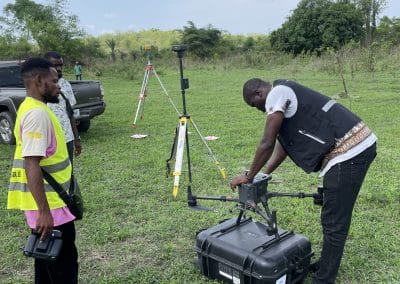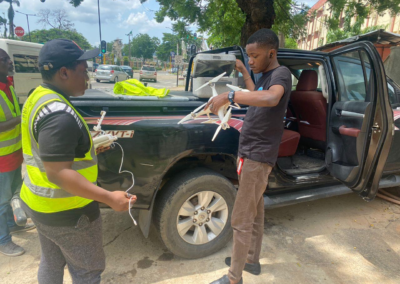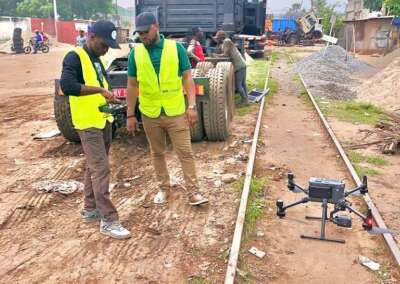

Picture the scene: a new agricultural drone arrives on a 60-hectare farm in Kano State. It is still in its casing. The operator is ready. The crops need treatment. Then the questions come. Where is the charger? Which generator powers it? What tank handles fertiliser broadcast rather than liquid spray? The drone alone does not leave the ground. If you are evaluating the DJI Agras T50 kit in Nigeria, this guide breaks down every component so you know exactly what you buy and why each piece matters.
Why the Complete Kit Matters
Most farmers focus almost entirely on the aircraft. That is understandable. However, it misses a critical point: the drone is the output of a system, not the system itself. The battery determines how long it flies. Furthermore, the charging station determines how quickly it returns to air. The generator determines whether any of that works far from grid power. In addition, the spreading tank determines whether you use the drone for fertiliser broadcast as well as liquid application.
Buying the drone alone and sourcing accessories separately is a common and costly mistake. Therefore, the smarter approach is to understand the full kit upfront and acquire it as one operational system. Geoinfotech supplies all five components together, with advisory support to match them correctly to your farm.
The Five Components, Explained
1. The DJI Agras T50 Drone
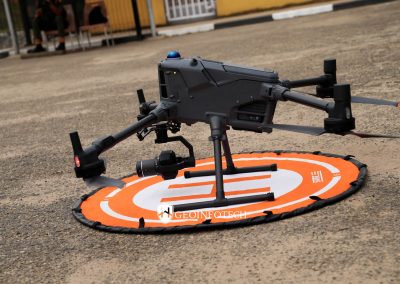
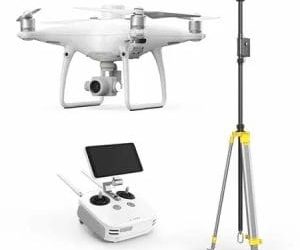
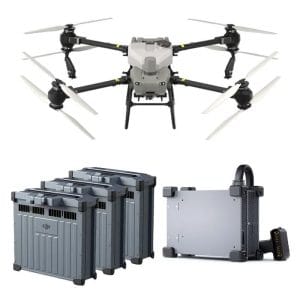
The aircraft is the foundation. The T50 carries a 40-litre liquid spray tank or up to 50 kilograms of dry spreading material. It covers up to 21 hectares per hour. Furthermore, its coaxial twin-rotor design with 54-inch propellers delivers stability under heavy load. The dual atomising spray system adjusts droplet sizes from 50 to 500 micrometres. As a result, spray width reaches up to 11 metres per pass. Active phased array radar and a binocular vision system handle obstacle detection and terrain following throughout each autonomous flight.
2. The DB1560 Intelligent Flight Battery
Each DB1560 battery holds 30,000 mAh at 52.22 volts and supports over 1,500 charge cycles. In field conditions, a single battery powers 6 to 10 minutes of flight. This aligns with the time needed to empty a full tank and return for a refill. Therefore, the workflow runs smoothly: you land to refill the tank, swap the battery at the same moment, and return to the air within minutes.
For serious operational tempo, run a minimum of three batteries. One sits in the drone. One charges. One cools before its next cycle. Consequently, Geoinfotech advises on the right battery count for your farm size and daily treatment targets.
3. The C10000 Intelligent Charging Station
The C10000 fast charges the DB1560 at 9,000 watts of output. It brings a battery from 30 percent to 95 percent in 9 to 12 minutes. Without the C10000, a standard charger needs over two hours per battery. As a result, that grounds your entire operation. The station weighs 11.2 kilograms, accepts 100 to 240 volts AC input, and works with both grid power and a generator.
In addition, built-in protection covers over-voltage, over-charge, under-voltage, and over-temperature conditions. In Nigeria’s heat, battery temperature management is critical. Therefore, these protections keep the system reliable through an entire farming season.
4. The Spreading Tank
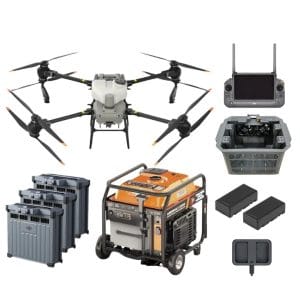
The standard liquid spray tank handles chemical application. However, the spreading tank is a separate, swappable system that converts the T50 into a granular broadcaster. It holds up to 75 litres of dry material and broadcasts at up to 108 kilograms per minute. Furthermore, a spiral channel spinning disk produces more uniform distribution than conventional spinner-plate systems.
For Nigerian farmers, the spreading tank unlocks basal fertiliser application, top-dressing with urea, and seed broadcasting across large plots. In addition, switching between spray and spreading tanks takes only minutes. As a result, the T50 becomes genuinely multi-purpose across different stages of a growing season.
5. The Generator
This component attracts the least attention at purchase time. However, it causes the most problems in the field. The C10000 charging station needs a generator with a minimum output of 12 kilowatts at 220 to 240 volts AC single-phase. A weaker generator cannot sustain fast charging. Consequently, ground time increases and efficiency falls.
DJI produces the D12000iE Multifunctional Inverter Generator for this purpose. Electronic fuel injection technology delivers roughly 15 percent better fuel economy than conventional generators. Therefore, for farms without grid access across northern and central Nigeria, a correctly specified generator makes the whole system viable.
Getting the Complete Kit in Lagos
Geoinfotech Resources Limited supplies the complete DJI Agras T50 kit in Nigeria and operates from Lagos. We serve farming operations across the country. Rather than sourcing each component separately, we help you plan and acquire the system as one matched unit.
We provide farm assessment, operator training, NCAA regulatory guidance, and after-sales technical support. Importantly, if you are evaluating the investment or comparing configurations, reach out before you buy. Getting the system right from the start saves significant cost and frustration over the life of the equipment.
A drone without the right kit is an expensive paperweight. The right kit, properly supported, transforms a farm.