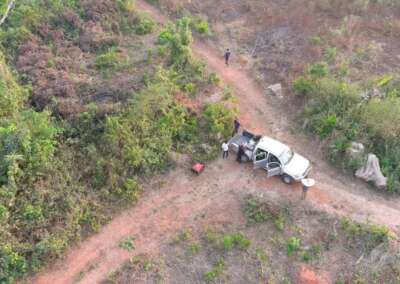

Picture the scene: a commercial rice farmer in Benue State stands at the edge of his 80-hectare field at dawn. His spraying contractor cancelled last minute. The fungicide window is closing. Hiring enough labour manually will take four days he does not have. Then a colleague calls. One drone. One operator. By early afternoon, the entire field receives treatment, uniformly and on time. If you are a Nigerian farmer researching the DJI Agras T50 in Nigeria, this guide will help you decide whether it belongs on your farm.
What the DJI Agras T50 Actually Does
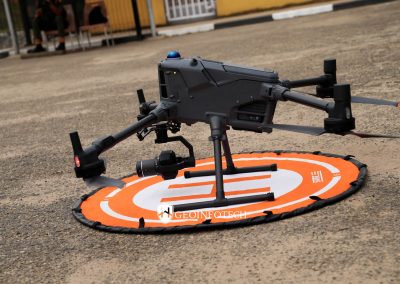
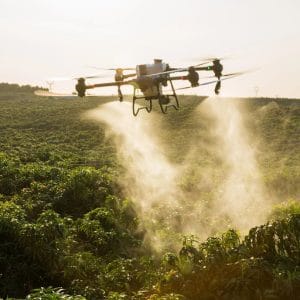
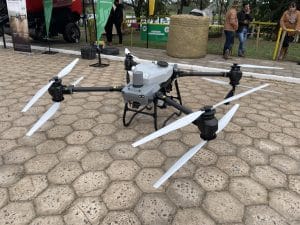
The Agras T50 is DJI’s most capable agricultural spraying and spreading drone. It carries a 40-litre liquid tank for spraying or up to 50 kilograms of dry material for spreading granular fertilisers and seeds. Furthermore, its coaxial twin-rotor system with 54-inch propellers delivers stability under heavy loads. As a result, spray patterns stay consistent across an entire field, not just the first few passes.
In terms of coverage, the T50 reaches up to 21 hectares per hour. For example, a 50-hectare farm takes under three hours with a single operator. The dual atomising spray system adjusts droplet sizes from 50 to 500 micrometres. In addition, spray width reaches up to 11 metres per pass.
Moreover, the T50 navigates fully autonomously. Active phased array radar and a binocular vision system detect obstacles, follow terrain, and maintain height above the canopy throughout each flight. The operator plans the route and sets the parameters. The drone then executes the entire mission.
Which Farms and Crops Does It Suit?
Geoinfotech recommends the T50 for farms from 30 hectares upward. Below that threshold, the investment takes longer to recover. However, at commercial scale, its speed and payload capacity produce genuine savings from the very first season. It excels across these crop types:
- Rice: wide, even canopies make it ideal for fungicide, herbicide, and foliar fertiliser application during critical growth windows
- Sugarcane: the T50’s height clearance and powerful rotors handle tall, dense structures that smaller drones cannot manage
- Maize and sorghum: consistent droplet penetration into the mid-canopy where disease pressure builds
- Cotton and soybeans: precise placement reduces input waste on high-value crops sensitive to over-application
- Spreading: granular fertiliser and seed broadcast across open plots at up to 1,500 kg of material per hour
On the other hand, the T50 suits less to fragmented smallholder plots, orchards with dense canopy closure, or fields with many tree obstacles. For those situations, the smaller DJI Agras T25 may be a better fit. Geoinfotech advises on both options.
Does the Investment Make Financial Sense?
For commercial farmers, the numbers are compelling. Consider treating 80 hectares with conventional methods. Manual labour with knapsack sprayers needs 20 to 25 workers over three to four days per round. Additionally, chemical wastage commonly runs at 25 to 35 percent due to uneven coverage and operator fatigue. As a result, labour costs alone can reach N300,000 to N450,000 per treatment round, before wasted inputs.
In contrast, with the Agras T50, one trained operator covers the same 80 hectares in a single working day. The dual atomising system applies product precisely, with far less drift than ground equipment. Therefore, over two to three growing seasons, most large-scale operators recover the acquisition cost and move into net savings.
Beyond cost savings, there is also a timing advantage. Treating on exactly the right day, rather than when labour happens to arrive, can determine whether a crop survives a disease event or does not.
What You Need to Operate It Properly
- NCAA registration: all commercial drone operations in Nigeria require Civil Aviation Authority approval before any flight over farmland
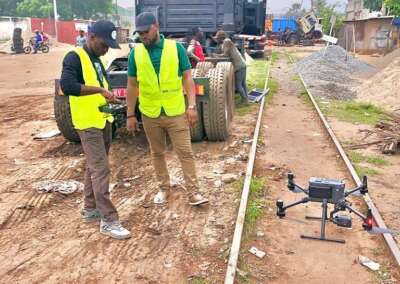
- Trained pilot: the T50 is a professional-grade system. Proper training on flight planning, battery management, emergency protocols, and the DJI Agras app is essential
- Power infrastructure: the DB1560 battery charges rapidly. However, you need a reliable power source on or near the farm for continuous operation across large plots
- Agronomic input knowledge: not all liquid formulations suit drone application. Emulsifiable concentrates, suspension concentrates, and water-dispersible granules each require different handling
Importantly, Geoinfotech supports buyers through the full process. We cover pre-purchase farm assessment, operator training, NCAA documentation, and ongoing technical support after every sale.
Where to Get the DJI Agras T50 in Nigeria
Geoinfotech Resources Limited supplies the DJI Agras T50 in Nigeria and operates from Lagos. We serve farming operations across the country, from the northwest grain belts to the Niger Delta and the Middle Belt. In addition to supply, we provide full pre-purchase advisory, operator training, and after-sales support.
Whether you farm commercially, run an agribusiness, or manage a cooperative spraying service, reach out to us before you buy. Consequently, a proper farm assessment before purchase saves time, money, and frustration over the life of the equipment.
The DJI Agras T50 is available in Nigeria today. The only question is whether your farm is next.