
REMOTE SENSING ELEMENTS EXPOSITORY
Elements of Remote Sensing
Remote Sensing Elements Expository involves various processes, procedures or steps in remote sensing. This, specifically, covers all the stages in remote sensing operation from the initial to the final stage.
Furthermore, it operates as a systematic sequence of energy generation, interaction, detection, transmission, and interpretation. Each stage is interdependent, and errors or distortions at any stage can affect the quality of the final data. These elements includes Emission of electromagnetic radiation, transmission through the atmosphere, interaction with the object, transmission of energy to the sensor, recording of energy by the sensor, and transmission of data to ground station and data processing.
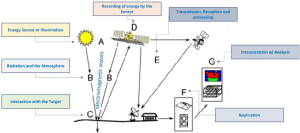
Figure 1a: Remote Sensing Elements and Mode of Operation/Technique
Remote Sensing Elements Expository: Emission of Electromagnetic Radiation (Energy Source)
This is the initial stage of the remote sensing process where energy is generated and directed toward the Earth’s surface. Electromagnetic radiation is the energy reflected, absorbed and emitted by an object and this is emitted in waves that are able to transmit energy from one place to another.
For instance, trees, air, soil, water, computer, building, the Sun, the Earth, all the stars and planets are reflecting and emitting a wide range of electromagnetic waves, these waves originate from billions of vibrating electrons, atoms, and molecules, which emits and absorbs electromagnetic radiation in unique combination of wavelengths. Any object with a temperature above absolute zero (-273°C) continuously reflects, absorbs, and emits energy in a unique manner. This energy is called electromagnetic radiation.
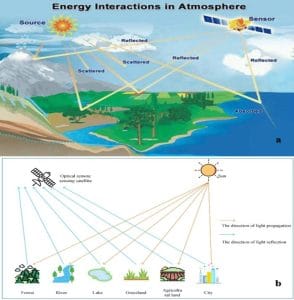
Figure 2: (a) Energy Interactions in Atmosphere (b): Light Propagation and Reflection
Sources of Electromagnetic Radiation (EMR)
Based on the source of energy or light, remote sensing (RS) is classified into two as active and passive RS. Electromagnetic radiation travels in the form of waves characterized by wavelength and frequency, which determines how energy interacts with objects.
Active Sensor
Active sensors generate their own energy. They have their source of light or illumination (energy) and their sensors measure reflected energy. In the case of active Remote Sensing, energy is generated and sent from the RS platform towards the targets.
Sensors onboard the remote sensing platform record the energy reflected from the targets while most of the microwave RS is done through Active RS. Examples include RADAR (Radio Detection and Ranging) and LiDAR (Light Detection and Ranging). These systems can operate day and night and are less affected by cloud cover (especially radar).
Passive Sensor
Passive sensors uses natural energy which is the sun. The sun is the primary source of energy for the passive sensor and it emits radiation across a wide spectrum (visible, infrared, ultraviolet). Most Earth observation satellites (e.g., optical sensors) rely on solar illumination and most of the RS systems work in passive mode, using solar energy as the source of EMR. They measures reflected sunlight that is emitted from the sun. Airborne and spaceborne sensors record solar energy reflected from targets within specific wavelength bands.
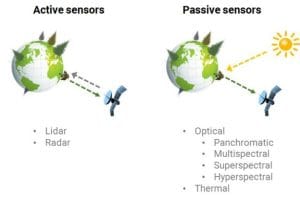
Figure 3: Active and Passive Sensor
Remote Sensing Elements Expository: Transmission through the Atmosphere to the Object on the Ground
As EMR travels from the source to the Earth’s surface, atmospheric constituents modify the signal. There are three major atmospheric effects which are scattering, absorption and atmospheric windows.
Scattering: This occurs when particles or gases redirect EMR. Scattering is of three types (Figure 4),
Namely;
- Rayleigh scattering (by small particles like air molecules; affects shorter wavelengths such as blue light),
- Mie scattering (by dust, smoke, water vapor) and
- non-selective scattering (by large particles like clouds; affects all wavelengths).
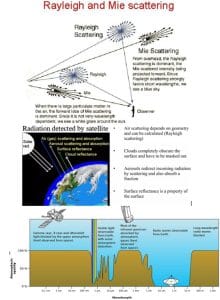
Figure 4: shows the process of transmission through the atmosphere in remote sensing including the major atmospheric effects (scattering, absorption and atmospheric windows) and wavelength.
Absorption: Certain gases absorb specific wavelengths and these are Ozone absorbs, ultraviolet radiation, Water vapor absorbs infrared radiation and carbon dioxide absorbs thermal radiation
Atmospheric Windows: This include the
- Regions where EMR passes through with minimal absorption and
- Sensors are designed to operate within these windows.
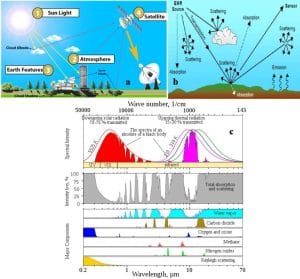
Figure 5: Remote Sensing Transmission Processes through the Atmosphere
Implication of transmission through the Atmosphere: Atmospheric interference can distort signals, so corrections (atmospheric correction) are often applied during data processing.
Interaction with the Object
When EMR reaches the Earth’s surface, it interacts with objects in three primary ways:
- Reflection: In this process, the surface reflects incoming energy back toward the sensor, the proportion reflected is called reflectance and reflection varies by material. For instance, vegetation reflects strongly in near-infrared, water absorbs most radiation and soil has moderate reflectance
- Absorption: Energy is absorbed and converted into heat. It also influences temperature and thermal emission.
- Transmission: Energy passes through the material (e.g., clear water, glass) and this depends on the spectral signature or characteristics of the object.
Spectral Signature
A spectral signature is a unique characteristic of an object that analysts use for identification. Each object has a unique pattern of reflection across wavelengths known as a spectral signature, which enables identification.
For example, Healthy vegetation: high near-infrared reflectance, Dry soil: higher reflectance in visible wavelengths, Water: low reflectance across most bands.
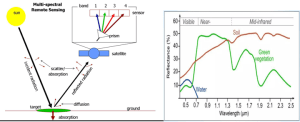
Figure 6: Interaction with the Object
Transmission of Energy to the Sensor
After interacting with the surface, reflected or emitted energy travels back through the atmosphere to the sensor.
The following considerations are required:
- Signals may again be scattered or absorbed,
- Distance between object and sensor affects signal strength.
- In addition, Angle of observation (sensor geometry) influences data quality.
The types of energy detected are reflected solar radiation (visible and near-infrared) and emitted thermal radiation (thermal infrared).
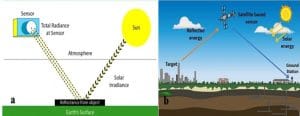
Figure 7: (a) Total Radiance at Senor and Solar irradiance, (b) Reflected Energy from Targeted Object in Remote Sensing
Recording of Energy by the Sensor
Sensors detect incoming radiation and convert it into measurable signals. The two types of sensors are photographic sensors (older systems) and electronic sensors (modern systems using CCD or CMOS detectors).
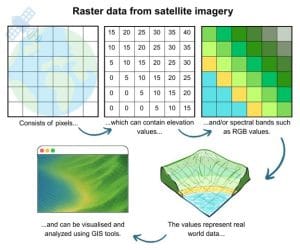
Three processes are involved in recording of energy by the sensor include Sensor elements (pixels) detect incoming energy, convert it into electrical signals, and quantify it as Digital Numbers (DNs). Resolution Factors are Spatial resolution: pixel size, Spectral resolution: number of bands, and Radiometric resolution: sensitivity to energy differences.
Figure 6b shows an electronic sensor measures intensity of the terrain and samples the analog electrical signal in an image then converts it to a digital number (DN).
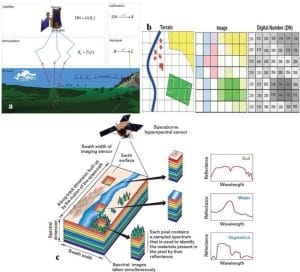
Figure 8: Recording of Energy by the Sensor
Transmission of Data to Ground Station
Satellite or airborne platform transmits the recorded data to Earth, the methods involve are direct downlink to ground receiving stations and relay satellites (e.g., communication satellites). At the ground stations facilities are equipped with antennas and receivers to collect raw data.
For example, earth observation satellites transmit data to global receiving networks for processing.
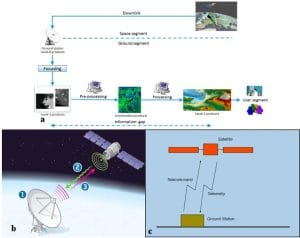
Figure 9: Transmission of Data to Ground Station
Data Processing
Analysts process raw data into usable formats before interpretation and the processing steps are (1) Radiometric Correction, (2) Removes sensor and atmospheric distortions, (3) Geometric Correction (Aligns image with geographic coordinates), (4) Image Enhancement (Improves contrast and visibility9, (5) Image Classification (Assigns pixels to categories (e.g., forest, water, urban)) and (6) False Color Composites (Combines bands to highlight features). Also, The outputs include digital images, maps and thematic datasets.
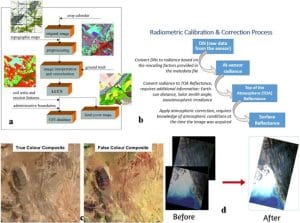
Figure 10: Data Processing Stages
Data Analysis and Interpretation
Data analysis and interpretation is the final and most critical stage, which involves the extraction of information for decision-making. Methods of analysis are Visual Interpretation: Based on tone, texture, shape, pattern, and color, Digital Analysis: Computer-based classification and algorithms, GIS Integration: Combining remote sensing data with other spatial datasets and Change Detection: Comparing images over time.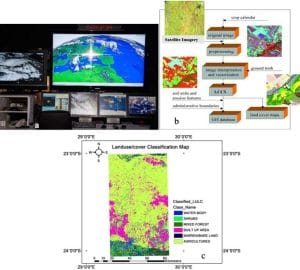
Figure 11: Data Analysis and Interpretation
Conclusion
Finally, the Remote Sensing Elements Expository process is a multi-stage system involving energy emission, atmospheric interaction, surface response, detection, transmission, processing, and interpretation. Each stage contributes to the accuracy and reliability of the final data product. A thorough understanding of these elements is essential for effective application in environmental monitoring, resource management, disaster response, and scientific research.