Vegetation index mapping is a core technique in remote sensing and GIS used to assess vegetation health, density, and spatial distribution over time. By transforming multispectral imagery into numerical indices, this method allows analysts to evaluate vegetation conditions objectively across local, regional, and global scales. Vegetation index mapping plays a critical role in agriculture, forestry, environmental monitoring, and land management.
Concept of Vegetation Index Mapping
Vegetation index mapping involves the mathematical transformation of spectral reflectance values derived from satellite, aerial, or drone imagery into indices that emphasize vegetation characteristics such as greenness, biomass, vigor, and stress. These indices simplify complex multispectral datasets into interpretable raster maps that support spatial analysis and decision-making.
The technique is based on the interaction between electromagnetic radiation and plant canopies. Healthy vegetation absorbs a large portion of visible red light due to chlorophyll activity while reflecting significant amounts of near-infrared (NIR) radiation because of leaf cellular structure. Stressed or sparse vegetation reflects more red light and less NIR radiation. Vegetation indices exploit this contrast to enhance vegetation signals while minimizing background effects from soil, water, and shadows.
Common Vegetation Indices Used in Mapping
The most widely used vegetation index is the Normalized Difference Vegetation Index (NDVI). NDVI is calculated using the normalized ratio between near-infrared and red reflectance values. NDVI values range from –1 to +1, where higher positive values represent dense and healthy vegetation, values near zero indicate bare soil or built-up areas, and negative values typically correspond to water bodies or clouds.
Several other vegetation indices have been developed to address specific limitations or analytical needs:
- Enhanced Vegetation Index (EVI) improves sensitivity in high-biomass regions and reduces atmospheric and soil background effects.
- Soil-Adjusted Vegetation Index (SAVI) incorporates a soil correction factor, making it suitable for arid and semi-arid environments.
- Green NDVI (GNDVI) emphasizes chlorophyll concentration and plant vigor.
- Difference Vegetation Index (DVI) highlights vegetation presence without normalization.
- Normalized Difference Red Edge Index (NDRE) is effective for crop stress detection using red-edge bands.
Each index serves specific applications depending on vegetation type, sensor characteristics, and study objectives.
Vegetation Index Mapping Workflow
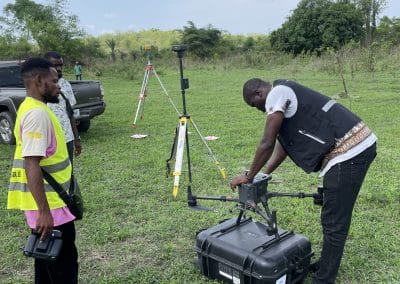
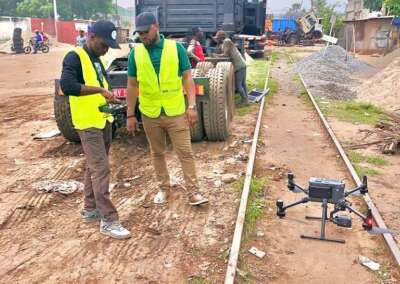
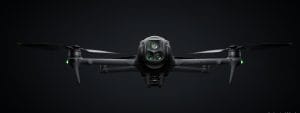
Vegetation index mapping begins with the acquisition of remotely sensed imagery from platforms such as satellites, unmanned aerial vehicles (UAVs), or manned aircraft. Common satellite sources include Landsat, Sentinel, and MODIS, while drones provide higher spatial resolution for localized studies.
Before index calculation, the imagery undergoes preprocessing to ensure data accuracy. These steps typically include radiometric correction, atmospheric correction, geometric correction, and cloud masking. Once preprocessing is complete, vegetation indices are computed using band math operations in GIS or remote sensing software.
The output is a raster vegetation index map that represents vegetation condition across the study area.
Interpretation of Vegetation Index Maps
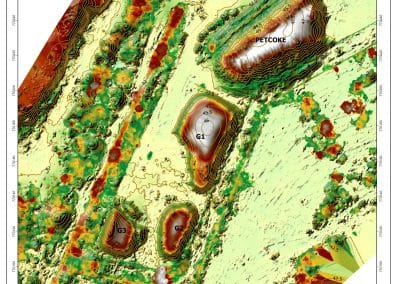
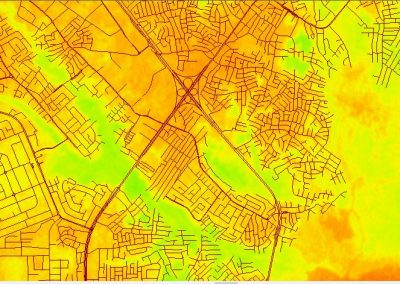
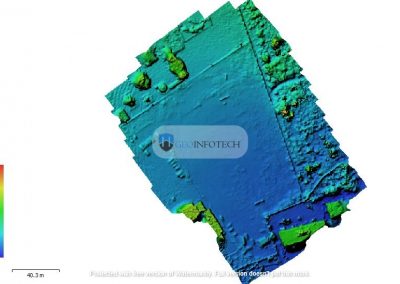
Vegetation index maps are usually visualized using color gradients to distinguish vegetation health and density. High index values are commonly displayed in darker green tones, indicating dense and vigorous vegetation. Lower values appear in lighter or brownish colors, representing sparse, stressed, or degraded vegetation.
Beyond visual interpretation, vegetation index values can be extracted for specific locations, parcels, or time periods. Repeated analysis over time enables trend assessment, seasonal monitoring, and detection of long-term vegetation changes driven by climate variability or human activities.
Applications of Vegetation Index Mapping
Vegetation index mapping has broad applications across multiple sectors:
- Agriculture: Supports precision farming by monitoring crop growth, detecting stress, and optimizing irrigation and fertilizer use.
- Forestry: Aids in biomass estimation, forest inventory, deforestation monitoring, and post-fire assessment.
- Environmental Monitoring: Helps evaluate ecosystem productivity, habitat quality, and land degradation processes such as desertification.
- Urban and Regional Planning: Assesses green cover distribution, urban heat island mitigation, and environmental impacts of development.
- Disaster Management: Enables drought monitoring, flood impact assessment on vegetation, and post-disaster recovery analysis.
Limitations of Vegetation Index Mapping
Despite its effectiveness, vegetation index mapping has limitations. Atmospheric effects, sensor noise, cloud cover, and varying illumination conditions can influence index values if not properly corrected. Soil background effects may distort results in areas with sparse vegetation, while saturation can occur in dense forests where indices like NDVI lose sensitivity. Vegetation indices also provide indirect indicators and should be validated with ground truth data for accurate interpretation.
Conclusion
Vegetation index mapping is a powerful geospatial technique that transforms raw remote sensing data into actionable insights on vegetation health, distribution, and change. By integrating spectral science, GIS analysis, and temporal monitoring, it supports informed decision-making in agriculture, forestry, environmental management, urban planning, and disaster response. As satellite systems, drone technology, and analytical methods continue to advance, vegetation index mapping will remain a critical tool for sustainable land and resource management.
For professional vegetation index mapping, GIS analysis, and geospatial services, Geoinfotech Resources Limited provides reliable solutions across agriculture, land surveying, environmental monitoring, construction, engineering, and oil and gas sectors in Nigeria and beyond.