
Introduction
Violence in Jos, Plateau State has remained a persistent security challenge, with recurring incidents causing significant loss of life across multiple communities. Rather than isolated events, data from 2020 to 2026 reveals a consistent and structured pattern of conflict.
Within this period, at least 62 recorded incidents resulted in approximately 4,547 fatalities. These attacks are highly concentrated in specific locations and often occur in cycles, highlighting a sustained pattern of high-impact violence across the region.
Scale of Violence in Jos (2020–2026)
The scale of violence in Jos is defined not just by frequency, but by the severity of individual incidents.
- Early data (2020) already shows high-fatality events, including a 327-death ambush in Bassa
- Between 2021 and 2023, repeated attacks produced 20–100+ fatalities per incident
- By 2024 and 2025, violence escalated significantly, with several attacks exceeding 100–500 deaths
These figures indicate a pattern of large-scale, high-impact attacks, often targeting entire communities rather than individuals.
In 2026, although data is still incomplete, incidents continue to result in double-digit fatalities, showing that the underlying drivers of violence remain active.
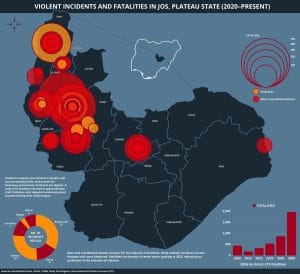
Geographic Hotspots of Violence in Plateau State
Violence in Plateau State is not evenly distributed. Instead, it is concentrated in key northern LGAs:
1. Barkin Ladi
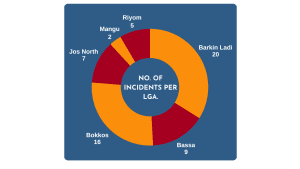
- 1,888 fatalities across 20 incidents
- Highest concentration of both frequency and severity
- Represents the most critical hotspot
2. Bokkos
- 1,068 fatalities across 16 incidents
- Repeated coordinated attacks on communities
3. Bassa
- 662 fatalities across 9 incidents
- Fewer incidents but higher severity per event
4. Jos North
- 189 fatalities across 7 incidents
- Urban-based violence, including armed attacks
5. Riyom
- 214 fatalities across 5 incidents
- Consistent contribution to the northern violence cluster
In contrast, areas like Mangu and Wase show significantly lower incident frequency and fatality counts.
This distribution highlights a clear spatial concentration of violence, with the majority occurring within a northern cluster of LGAs.
Types of Violent Incidents
Violence in Jos can be categorized into two main types:
1. Mass and Coordinated Attacks
- Target communities, worship centers, and residential areas
- Account for the majority of fatalities
- Often result in large casualty spikes
2. Ambush and Targeted Attacks
- Smaller-scale incidents
- Focus on individuals or small groups
- Lower fatality counts but more dispersed
Overall, coordinated attacks are the primary drivers of total fatalities, while ambushes contribute to the spread of violence across locations.
Trends in Violence Over Time (2020–2026)
A year-by-year analysis reveals a clear upward trend:
- 2020: 443 fatalities
- 2021: 177 fatalities (temporary decline)
- 2022: 333 fatalities
- 2023: 537 fatalities
- 2024: 868 fatalities
- 2025: 1,973 fatalities (peak year)
- 2026 (Jan–Apr): ~216 fatalities
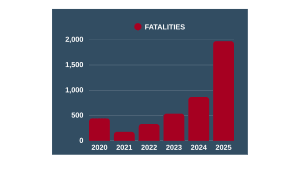
The sharp increase in 2025 reflects a concentration of high-fatality incidents, marking the most intense period of violence in the dataset.
Despite fluctuations, the overall trajectory shows:
- Increasing severity of attacks
- Rising fatality counts
- Continued frequency of incidents
This indicates a worsening security situation rather than improvement.
Conclusion: Understanding the Pattern of Violence in Jos
Violence in Jos and Plateau State is:
- Not random – it follows identifiable patterns
- Geographically concentrated – focused in specific LGAs
- Driven by high-impact attacks – not just frequent incidents
- Increasing over time – especially since 2023
The data clearly shows that this is a systemic and recurring crisis, not a series of isolated events. The persistence of these patterns suggests that the underlying causes of violence remain unresolved, with no clear signs of decline as of 2026.